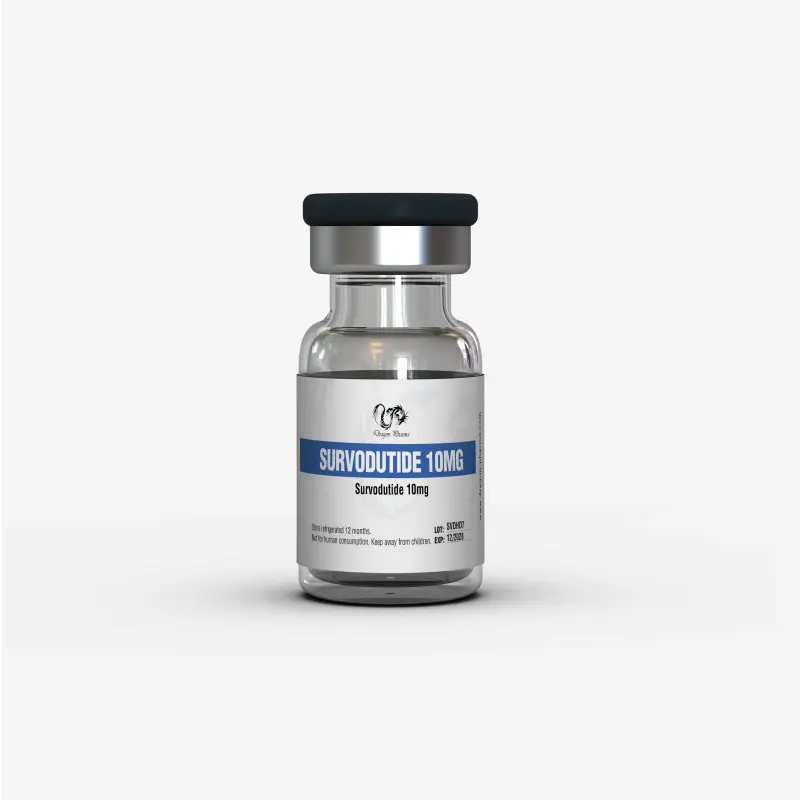
SURVODUTIDE 10mg
- Pack Size: vial
- Concentration: 10 mg/ml
- International
- U.S. Domestic
- USA MADE 2-7 days delivery
- International 5-20 days delivery
Note: Peptides will arrive in a powder form for maximum stability!!!
Survodutide (10mg) is a specialized research reagent utilized primarily to investigate multi-receptor metabolic signaling and systemic energy homeostasis. As a "dual agonist," it acts simultaneously on the glucagon-like peptide-1 (GLP-1) and glucagon (GCG) receptors. Dragon Pharma provides Survodutide 10mg at a purity level of 99%+, specifically for use in in-vitro laboratory experiments and preclinical animal models.
Overview
In the realm of metabolic research and cellular energetics, few compounds offer as much utility as Survodutide (BI 456906). Known scientifically as a dual-pathway incretin mimetic, this compound has become a fundamental tool for investigators exploring the synergistic effects of gut-hormone signaling and hepatic glucose regulation. Dragon Pharma provides Survodutide 10mg at a minimum purity of 99%, ensuring that researchers have access to a high-grade Research Peptide capable of producing reproducible and accurate data in complex biological models.
As scientific inquiry into obesity-related metabolic dysfunction, non-alcoholic steatohepatitis (NASH/MASH), and cardiovascular resilience expands, the need for reliable dual agonists like Survodutide has grown. This expanded profile examines the biochemical characteristics, structural integrity, and multifaceted research applications of Survodutide 10mg.
Molecular Characteristics and Chemical Profile
The structural integrity of Survodutide is what allows it to activate two distinct receptor pathways concurrently. It is a synthetic peptide engineered for enhanced stability and a prolonged biological half-life compared to endogenous ligands.
- Chemical Identity: Survodutide (GLP-1/Glucagon Receptor Dual Agonist)
- Molecular Formula: C192H289N47O61
- Molecular Weight: 4578.07 g/mol
- Purity: >99% (HPLC and Mass Spectrometry verified)
- Form: Lyophilized powder
- Manufacturer: Dragon Pharma
Research Applications
The peptide is utilized in various scientific investigative domains, including:
- Dual-Pathway Signaling: Mapping the coordinated activation of GLP-1 and Glucagon receptors.
- Hepatic Lipid Dynamics: Investigating the reduction of liver fat and modulation of lipid oxidation.
- Energy Expenditure: Assessing changes in metabolic rate and thermogenesis in animal models.
- Satiety Mechanisms: Studying central nervous system pathways related to food intake and appetite suppression.
- Fibrosis Modulation: Researching the impact of dual agonism on hepatic inflammatory signaling and scar tissue formation.
Pathway and Mechanistic Context
The core value of Survodutide 10mg in a laboratory setting is its ability to manipulate the Metabolic Balance by combining two complementary mechanisms. While GLP-1 agonists focus on insulin secretion and satiety, the inclusion of glucagon receptor agonism increases energy expenditure.
The GLP-1R / GCGR Signaling Axis
Upon activation by Survodutide, cells initiate a global shift in energy management:
- GLP-1 Receptor (GLP-1R): Initiates insulinotropic effects and slows gastric emptying, primarily targeting satiety centers in the brain.
- Glucagon Receptor (GCGR): Increases hepatic energy expenditure and promotes the "burning" of fatty acids, directly influencing metabolic flexibility.
Key Mechanistic Shifts:
- Enhanced Thermogenesis: Survodutide promotes a shift toward energy consumption, facilitating studies on weight modulation that go beyond simple caloric restriction.
- Lipid Metabolism: It inhibits the accumulation of fat in the liver by accelerating fatty acid oxidation.
- Glycemic Stability: Despite the inclusion of glucagon (traditionally a glucose-raiser), the GLP-1 component ensures balanced insulin production to maintain homeostasis in research models.
Primary Research Applications
1. Advanced Metabolic Syndrome and Obesity Research
Survodutide is heavily utilized in studies involving insulin resistance and weight-regulation failure. Because it mimics the metabolic benefits of both satiety and increased energy expenditure, it provides a unique framework for investigating the resolution of obesity-related comorbidities.
2. Hepatology and MASH (NASH) Studies
Known in research circles for its "liver-restorative" potential, Survodutide is used to observe how hepatic tissues adapt to chronic lipid stress. Investigators study changes in liver enzymes and the potential reversal of steatohepatitis in fibrotic models.
3. Cardiovascular and Ischemic Preconditioning
In cardiac research models, Survodutide is investigated for its potential to improve endothelial function. Research models focus on how dual-receptor engagement can protect tissues from oxidative stress and improve overall cardiovascular resilience.
Form and Analytical Testing
At Dragon Pharma, the commitment to scientific accuracy begins with a rigorous manufacturing process. Survodutide 10mg is produced under strict laboratory conditions to ensure the compound remains stable and bioactive.
- Lyophilization for Stability: The compound is supplied in a lyophilized (freeze-dried) form. This process removes moisture while preserving the molecular structure, which is critical for maintaining a long shelf life.
- Rigorous Analytical Verification: To guarantee a purity level of 99% or higher, every batch undergoes High-Performance Liquid Chromatography (HPLC) and Mass Spectrometry (MS) to confirm that the chemical signature matches the intended Survodutide profile.
Product Usage Disclaimer: This product is intended for laboratory and in-vitro research use only. It is not approved for human or veterinary application. Must be handled by qualified professionals. Not for drug, food, or cosmetic purposes. Misuse or misbranding is strictly prohibited.
Author:
All information was searched/edited by Dr. S. Edwin, and Dr. E. Croft who holds a doctorate from Case Western Reserve University School of Medicine
Storage, Handling, and Reconstitution
For the best results in your research, proper handling of Dragon Pharma Survodutide is essential:
- Storage: Lyophilized vials should be stored at -20°C for long-term stability.
- Reconstitution: Use sterile, bacteriostatic water or saline. Gentle agitation (swirling) is recommended; avoid vigorous shaking to prevent denaturing the peptide bonds.
- Shelf Life: Once reconstituted, the solution should be refrigerated at 2°C to 8°C and utilized within 14 to 21 days to ensure maximum potency.
-40% OFF
BPC 157 5mg
-40% OFF
CJC-1295 DAC 5mg
-40% OFF
IGF-1 LR3 1mg
-40% OFF
IPAMORELIN 5mg
-40% OFF
MOTS-c 10mg
-40% OFF
TB 500 10mg
Insights
How to Pair Diet and Exercise with Weight Loss Peptides
Tesamorelin Benefits for Visceral Fat Reduction and Metabolic Health
IGF-1 LR3 Peptide Explained: A Beginner’s Guide to Muscle Growth and Cellular Repair

Master Your Sleep, Master Your Life: The Performance Benefits of Sleep Peptides

99% Purity
Ensuring the highest standard with 99% purity.

Quality Ingredients
Crafted with purity and quality ingredients at the core.

Fast Shipping
Fast, reliable shipping straight to your door.

No TFA or Fillers
Nothing extra, just science: no TFA, no fillers.
Peptide Quality You Can’t Find Elsewhere!
| Dragon Peptides | Leading Competitor | |
|---|---|---|
| 200+ Peptide Variants |  |
 |
| USA-Manufactured Research Grade | |
|
| WHO/GMP & ISO 9001:2015 Certified | |
|
| Third-Party Tested for Purity | |
|
| Certificates of Analysis Provided | |
|
| Competitive Pricing Without Compromise | |
|
| Secure & Discreet Shipping | |
|

Quality You Can Rely On — Guaranteed
At PeptideHubs, scientific integrity and product reliability are at the core of everything we do. Each compound is manufactured and tested under strict quality control protocols to ensure consistency, purity, and performance for research applications.
However, if for any reason our product does not meet your research expectations, we offer a 60-day money-back guarantee — providing a risk-free procurement experience for qualified researchers and institutions.
Your research deserves uncompromised quality — and we stand behind every order to ensure you receive.