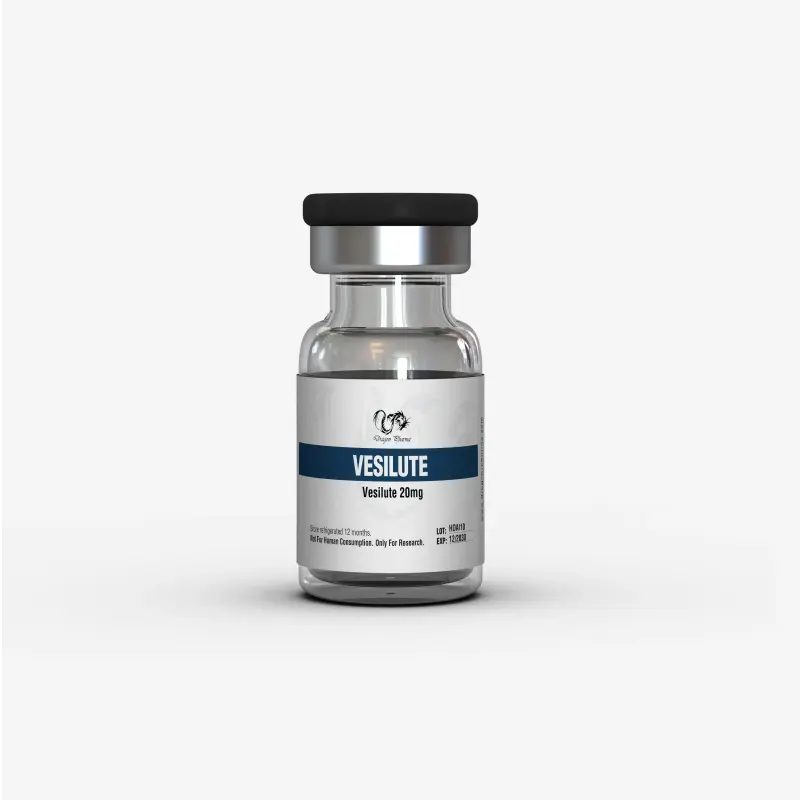
VESILUTE
- USA MADE 2-7 days delivery
- International 5-20 days delivery
for: Boosts Testosterone; Enhances Vitality.
Molecular Formula: C9H14N2O7
Molecular Weight: 262.20 g/mol
Brand: Dragon Pharma Peptide Line
Concentration: 20 mg
Overview of Vesilute Peptide
Vesilute is a bioregulator peptide composed of a short amino acid sequence, glutamic acid and aspartic acid (Glu–Asp, ED), and is investigated primarily within scientific and laboratory research settings for its potential biological regulatory properties.
Molecular and Scientific Classification
- Vesilute is a synthetic dipeptide bioregulator with a defined Glu–Asp amino acid sequence.
- It is classified within a group of peptides commonly referred to as Khavinson peptides, which are studied for their potential tissue-specific regulatory activity at the cellular level.
- Vesilute is designated exclusively for laboratory research purposes and is not approved for use as a therapeutic agent, pharmaceutical product, dietary supplement, or food for either human or veterinary application.
Research Applications and Areas of Investigation
In experimental and preclinical research models, Vesilute is primarily explored for its potential effects on urogenital tissues and cellular regulatory mechanisms, including:
- Bladder and urinary tract research, with focus on smooth muscle regulation and functional tissue support.
- Prostate-related studies, particularly in the context of microcirculatory dynamics and cellular behavior within prostate tissue.
- Cellular regeneration and gene expression investigations, where Vesilute is hypothesized to influence chromatin structure and transcriptional activity in select cell populations.
- Anti-inflammatory and cytoprotective research, especially in models of chronic inflammation or degenerative changes affecting urogenital tissues.
Rationale for Use in Research Settings
Vesilute is manufactured in accordance with stringent quality control standards, including precise molecular weight verification and compositional consistency across production batches. This level of standardization ensures reproducibility and reliability for laboratory experimentation.
Its stability and defined biochemical profile make Vesilute a valuable research compound for studies examining cellular signaling, tissue response, inflammation, and proliferative processes within urogenital and related biological systems. Research involving Vesilute contributes to the broader scientific understanding of peptide-mediated regulation and may inform future translational investigations relevant to human health and disease prevention.
Comparison of Vesilute With Other Bioregulator Peptides (Research Context)
| Peptide | Amino Acid Sequence | Primary Tissue Focus (Research) | Key Research Areas | Classification |
|---|---|---|---|---|
| Vesilute | Glu–Asp (ED) | Bladder, prostate, urinary tract | Urogenital tissue regulation, smooth muscle activity, microcirculation, inflammation, gene expression | Tissue-specific bioregulator peptide |
| Thymalin | Glu–Ala–Asp–Gly | Immune system (thymus) | Immune modulation, immune–endocrine balance, cellular aging | Immune bioregulator peptide |
| Epitalon | Ala–Glu–Asp–Gly | Pineal gland | Circadian rhythm regulation, telomerase activity | Anti-aging bioregulator peptide |
| Vilon | Lys–Glu | Immune and epithelial tissues | DNA synthesis, cell differentiation, immune response | Immune/tissue bioregulator peptide |
| Pinealon | Glu–Asp–Arg | Central nervous system | Neuroprotection, neuronal gene expression | Neuro-specific bioregulator peptide |
| Cartalax | Ala–Glu–Asp–Gly | Cartilage | Cartilage regeneration, extracellular matrix regulation | Structural tissue bioregulator peptide |
Suggested Peptide Combinations in Experimental Research
To expand the scope of investigation, Vesilute is sometimes studied in combination with other peptides commonly examined for tissue, neuroimmune, or systemic regulatory pathways, including:
- BPC-157 – researched for its involvement in tissue repair mechanisms and modulation of inflammatory responses.
- GHK-Cu – studied for its role in angiogenesis, extracellular matrix remodeling, and connective tissue repair.
- Selank – explored for neuroimmune regulation, with relevance to pelvic floor and urogenital system research models.
- AOD 9604 – examined in metabolic research and for potential synergistic effects in organ-focused peptide studies.
All peptide combinations are utilized strictly within controlled laboratory environments to evaluate complementary biological pathways, cellular interactions, and mechanistic outcomes.
FAQ
Can Vesilute be combined with other peptides in research studies?
Yes. In laboratory research, Vesilute may be studied alongside other peptides, such as BPC-157, GHK-Cu, Selank, Thymalin, or AOD 9604, to explore complementary or synergistic biological pathways. All such combinations are strictly limited to experimental and investigational use.
What are the primary research applications of Vesilute?
Vesilute is primarily investigated in experimental models focusing on bladder, prostate, and urinary tract function. Research areas include smooth muscle regulation, microcirculation, cellular proliferation, gene expression, and inflammatory processes affecting urogenital tissues.
Product Usage Disclaimer: This product is intended for laboratory and in-vitro research use only. It is not approved for human or veterinary application. Must be handled by qualified professionals. Not for drug, food, or cosmetic purposes. Misuse or misbranding is strictly prohibited.
Peptide Storage Instructions:
Vesilute peptide is supplied as a sterile, lyophilized (freeze-dried) powder in sealed vials. Proper storage is critical to preserve peptide stability and integrity.
Lyophilized powder (unopened vial):
Store in a dry, desiccated environment at temperatures below −18 °C, with −20 °C or −80 °C recommended for long-term storage. Protect from light and moisture at all times. Under these conditions, the lyophilized material remains stable for several years. Short-term storage at room temperature (up to three weeks) is acceptable, provided the vial remains sealed and shielded from humidity and light.
After reconstitution:
Reconstitute the powder using sterile, bacteriostatic water in a controlled laboratory setting, following appropriate biosafety procedures. Once reconstituted, store the solution at 2–8 °C for short-term use (approximately 3–4 weeks), or freeze aliquots at −20 °C or lower for extended storage. Repeated freeze–thaw cycles should be avoided, as they accelerate degradation. For long-term storage, preparing sterile aliquots prior to initial freezing is strongly recommended.
All storage containers should be protected from direct light and kept sealed, preferably in opaque containers with desiccant when applicable. Prevent any moisture exposure to the lyophilized powder during storage.
-40% OFF
BPC 157 5mg
-40% OFF
CJC-1295 DAC 5mg
-40% OFF
IGF-1 LR3 1mg
-40% OFF
IPAMORELIN 5mg
-40% OFF
MOTS-c 10mg
-40% OFF
TB 500 10mg
Insights
Dragon Pharma Hexarelin Now Available in Stock
Muscle Building Peptides for Women: The Complete Guide to Lean Muscle, Fat Loss, and Recovery
Beyond Melatonin: Sleep Peptides, Body Restoration, and Adipotide For Sale Insights
Peptide Reconstitution Guide

99% Purity
Ensuring the highest standard with 99% purity.

Quality Ingredients
Crafted with purity and quality ingredients at the core.

Fast Shipping
Fast, reliable shipping straight to your door.

No TFA or Fillers
Nothing extra, just science: no TFA, no fillers.
Peptide Quality You Can’t Find Elsewhere!
| Dragon Peptides | Leading Competitor | |
|---|---|---|
| 200+ Peptide Variants |  |
 |
| USA-Manufactured Research Grade | |
|
| WHO/GMP & ISO 9001:2015 Certified | |
|
| Third-Party Tested for Purity | |
|
| Certificates of Analysis Provided | |
|
| Competitive Pricing Without Compromise | |
|
| Secure & Discreet Shipping | |
|

Quality You Can Rely On — Guaranteed
At PeptideHubs, scientific integrity and product reliability are at the core of everything we do. Each compound is manufactured and tested under strict quality control protocols to ensure consistency, purity, and performance for research applications.
However, if for any reason our product does not meet your research expectations, we offer a 60-day money-back guarantee — providing a risk-free procurement experience for qualified researchers and institutions.
Your research deserves uncompromised quality — and we stand behind every order to ensure you receive.